
Electric Bill Calculator
Your electricity bill is mostly kilowatt-hours multiplied by your rate, plus fixed charges and taxes. This calculator estimates it two ways — from a list of your appliances and how long you use them, or from meter readings — and shows which appliances cost the most so you know where saving energy pays off.
- Free to use
- No sign-up
- Runs in your browser

Electric bill calculator
From appliances
…or from meter readings
Home Energy Tracker Pack
Excel appliance energy calculator, monthly meter reading and bill tracker, a home energy audit checklist and an energy-saving action plan.
- Appliance calculator (XLSX)
- Bill tracker (XLSX)
- Energy audit (PDF/DOCX)
- Action plan (PDF/DOCX/XLSX)
Formats: XLSX, PDF, DOCX. Instant download after payment (link valid 72 hours, up to 5 downloads). AI-assisted: the templates were drafted with AI help and reviewed and laid out before publishing.
$5.00 USD, one-time 4 files · about $1.25 each
- Instant download
- 7-day refund
- Secure checkout by Stripe
7-day money-back guarantee. Full refund within 7 days of purchase, even after you download.
Free sample: Appliance Energy Calculator (PDF, 57 KB)
Full refund within 7 days — see the refund policy and license.
Free printables
Single sheets you can print right now, no sign-up. The full pack adds every sheet in one download plus the editable files.
 Printable Energy-Saving Action Plan
How an electric bill is calculated
| Part of the bill | How it’s worked out |
|---|---|
| Energy use (kWh) | Current meter reading − previous reading |
| Energy charge | kWh × rate (or tiers: first block at one rate, the rest at another) |
| Delivery / distribution | Often a separate per-kWh charge — add it to your rate for estimates |
| Fixed charge | A monthly customer or service charge, whatever you use |
| Taxes and fees | Usually a percentage of the charges |
| Time-of-use | Some plans charge more at peak times — use an average rate for estimates |
Look at a recent bill to find your total price per kWh (supply plus delivery) and any fixed charge, and enter them above.
Appliance energy use
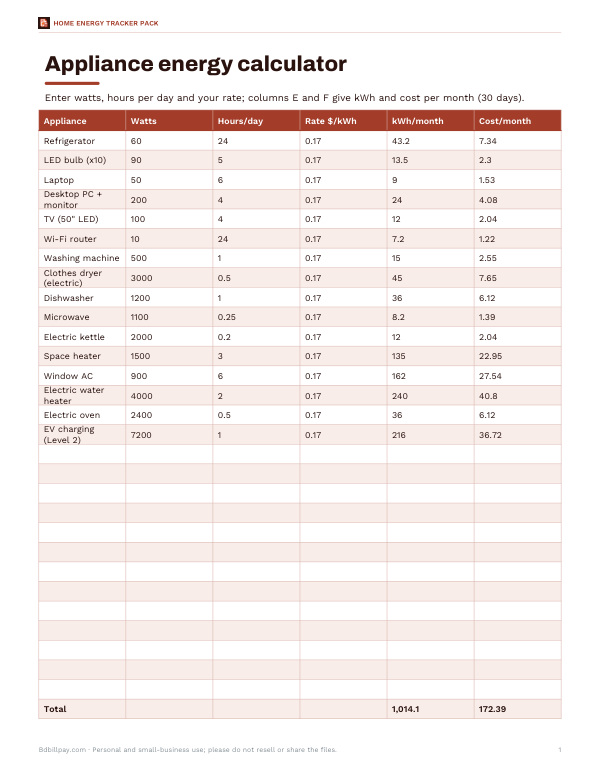
| Appliance | Typical watts | Hours/day | kWh per month (30 days) | Cost at $0.17/kWh |
|---|---|---|---|---|
| Refrigerator | 60 | 24 | 43.2 | $7.34 |
| LED bulb (x10) | 90 | 5 | 13.5 | $2.30 |
| Laptop | 50 | 6 | 9.0 | $1.53 |
| Desktop PC + monitor | 200 | 4 | 24.0 | $4.08 |
| TV (50" LED) | 100 | 4 | 12.0 | $2.04 |
| Wi-Fi router | 10 | 24 | 7.2 | $1.22 |
| Washing machine | 500 | 1 | 15.0 | $2.55 |
| Clothes dryer (electric) | 3000 | 0.5 | 45.0 | $7.65 |
| Dishwasher | 1200 | 1 | 36.0 | $6.12 |
| Microwave | 1100 | 0.25 | 8.3 | $1.40 |
| Electric kettle | 2000 | 0.2 | 12.0 | $2.04 |
| Space heater | 1500 | 3 | 135.0 | $22.95 |
| Window AC | 900 | 6 | 162.0 | $27.54 |
| Electric water heater | 4000 | 2 | 240.0 | $40.80 |
| Electric oven | 2400 | 0.5 | 36.0 | $6.12 |
| EV charging (Level 2) | 7200 | 1 | 216.0 | $36.72 |
Wattages are typical ranges for common models; actual figures vary widely. The label or manual lists the rated power, and a plug-in energy meter shows real consumption.
The formula
kWh = watts × hours ÷ 1,000. A 1,500 W space heater running 3 hours a day uses 1,500 × 3 ÷ 1,000 = 4.5 kWh a day, or 135 kWh in a 30-day month. At $0.17 per kWh that’s about $22.95 a month. Anything that heats or cools — heaters, dryers, water heaters, air conditioners, ovens — tends to dominate a bill, while phone chargers and LED bulbs cost very little.
Worked example
A household enters its bill details — $0.17 per kWh, a $12 fixed charge and 6% taxes — and ticks the refrigerator, lights, laptop, TV, router, washing machine, microwave and kettle. The calculator estimates 120 kWh a month and a bill of about $34.37, with the refrigerator the largest single user. Their meter readings show more — so they add the electric water heater, which accounts for much of the difference and becomes the first target for savings.
Ways to lower the bill
- Heating and cooling: a programmable thermostat and a degree or two of setback.
- Water heating: lower the thermostat to a safe setting (many sources suggest about 120 °F / 49 °C) and fix drips.
- Laundry: wash in cold water and use full loads; air-dry when you can.
- Lighting: switch remaining incandescent or halogen bulbs to LED.
- Standby power: turn off power strips for TVs and computers you aren’t using.
- Check your plan: time-of-use or different tariffs may suit your usage better.
Reading your meter
Most electricity meters show a cumulative kWh total. Read it at the start and end of the period you want to measure — or use the readings printed on your bill — and subtract. Smart meters often show the same total on their display, and many utilities let you download daily or even hourly readings from your online account, which are ideal for spotting which days or hours use the most. Note whether a reading on your bill is actual or estimated: estimated readings are corrected on a later bill.
Understanding tiered and time-of-use rates
| Rate type | How it works | Estimating tip |
|---|---|---|
| Flat | Same price for every kWh | kWh × rate |
| Tiered | A lower price for the first block of kWh, higher above it | Enter the tier threshold and second rate above |
| Time-of-use | Higher prices at peak hours, lower off-peak | Use an average rate, or estimate peak and off-peak use separately |
| Demand charges (rare for homes) | Based on the highest power used in a short interval | Check your tariff document |
Your utility’s tariff page or the back of your bill explains which structure applies.
Privacy
All calculations run in your browser.
Frequently asked questions
How do I calculate my electric bill?
Multiply kWh used by your rate, add fixed charges, then add taxes and fees.
How do I calculate kWh?
Watts × hours ÷ 1,000.
What uses the most electricity at home?
Usually heating, cooling, water heating and other appliances that heat things.
What is a fixed charge?
A monthly fee for being connected, charged whatever you use.
Why is my bill higher than the estimate?
Unlisted appliances, heating and cooling, and delivery charges are common reasons.
Is my data saved?
No. Everything stays in your browser.
How many kWh does a home use per month?
It varies widely with climate, home size and heating and cooling; your bill shows your own history.
Does unplugging chargers save much?
Usually very little — heating, cooling and hot water matter far more.
How do I find an appliance’s wattage?
Check the label or manual, or measure it with a plug-in energy meter.
Is it cheaper to run appliances at night?
Only on time-of-use plans with cheaper off-peak rates; on flat rates the time doesn’t matter.
What is a kilowatt-hour?
The energy used by a 1,000-watt device running for one hour.